Free Excel Template
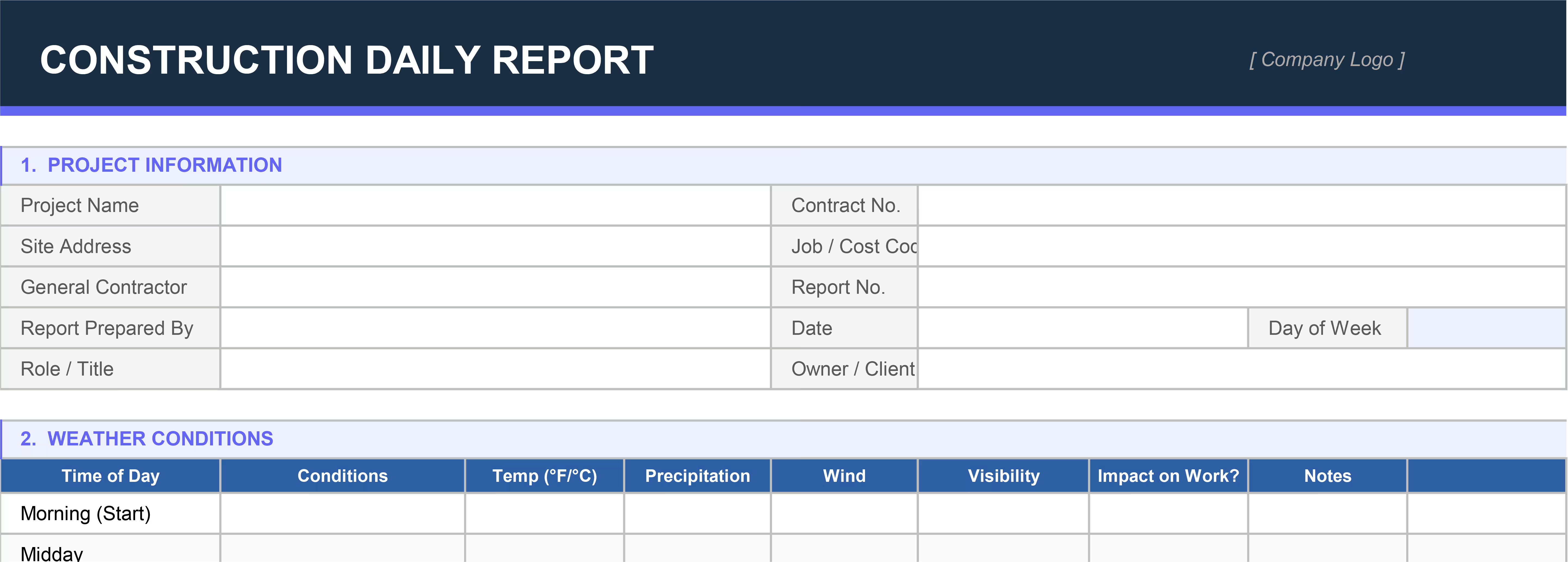
The construction daily report that holds up in a dispute
Get a consistent daily record that holds its own when a claim, change order, or dispute lands on the table. Built for the site teams filling it in and the project teams who need it to stick.
- Microsoft Excel (.xlsx)
- Easy to fill in
- US & UK compliant
Oops! Something went wrong while submitting the form.
WHAT'S INSIDE
Not all daily reports are defensible
Most stop at crew counts and a notes field. This one includes the two sections that matter most when a claim or change order is disputed.
- A dedicated delay and disruption section
The fields that matter when an extension of time or change order is disputed: cause, responsible party, time impact, and whether a notice was issued on the day. - An instructions received log
Verbal directions from the owner or design team, logged on the day with issuer, description, and potential impact. The record behind a constructive change claim. - Made for the record, not just the report
Activity logged with quantities, location, and trade. A countersignature block for the owner's representative.
The construction daily report that holds up in a dispute
Get the free templateBUILT FOR CONTRACT RIGOR
What you capture today determines what you can prove later
Construction disputes are won and lost on documentation quality. Here's why the format of your daily report matters more than most teams realize.
- Contemporaneous records are harder to challenge
Courts and adjudicators consistently give more weight to records completed on the day than to records reconstructed from memory. A daily report written three weeks later is a recollection, and opposing counsel will treat it accordingly. - Delay starts with a daily record
Forensic schedule analysts use daily logs to build the as-built schedule that underpins any delay claim. Without consistent daily records, the as-built is reconstructed from memory, and opposing counsel will systematically dismantle it. - Verbal instructions need a paper trail
When an owner or design team member verbally directs work, the contractor's daily log is often the only contemporaneous record that the instruction was given. Without it, a constructive change claim becomes a credibility contest.
WHO USES THIS
Practical on site. Credible in the office.
Whether you're filling it in at the end of a shift or reviewing it across a portfolio, this template is built around how your role actually works.
- Site Superintendent / Site Manager
Your records are the project's memory. A standard format means every shift is documented the same way, whether it's a normal day or one you'll need to account for six months from now. - Project Manager / Project Executive
The delay log gives you a running picture of time impacts across active projects, before they become formal disputes. The instructions log means you're not reconstructing who said what when change order negotiations get difficult. - Quantity Surveyor / Project Controls Manager
When an EOT application or change order needs to be substantiated, the daily record is your evidence base. This template captures workforce deployed, work disrupted, instructions received, and time lost, on the day, not after the fact. - Project Director / Commercial Director
Inconsistent daily reporting across your portfolio is a liability that only shows up when a dispute does. A shared standard your site teams will actually use closes that gap before it costs you.
Frequently Asked Questions
What's in this template, and how is it different from a basic daily log?

What's the difference between this free template and Shape?
Can I customize this template for our project or company format?
Does this template work for NEC4 and JCT contracts?
Why are construction daily reports important for delay claims?
Who should be completing the daily report on a construction project?
How long should construction daily reports be kept?